

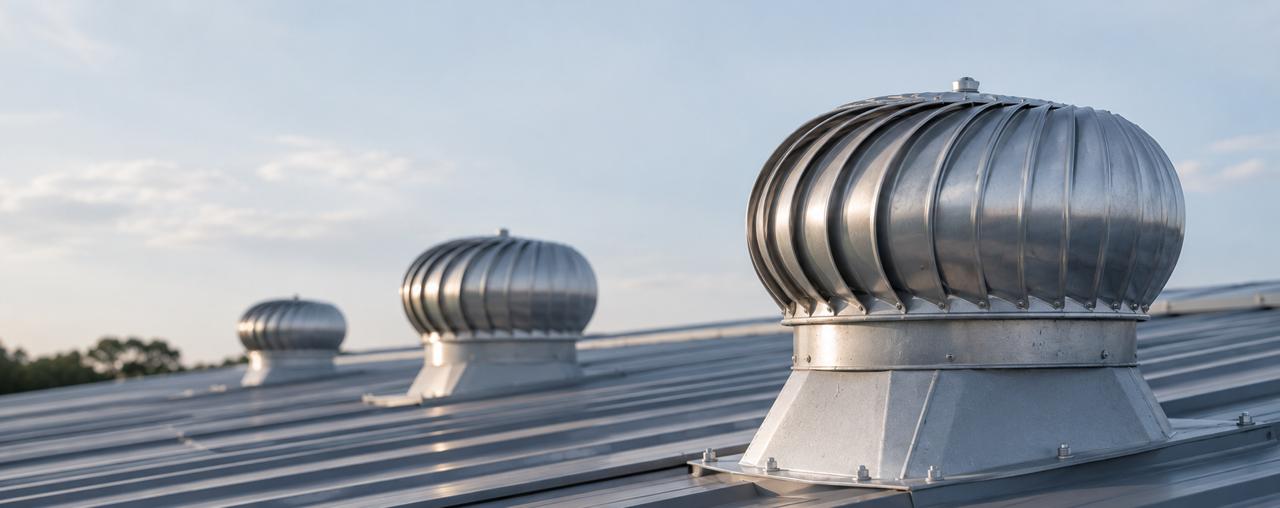
Role of turbo ventilators in steel roofing systems, from reducing roof-level heat and controlling condensation to improving ventilation and energy efficiency.
Walk into any large industrial building in India during summer and the problem is immediate: stifling heat beneath the roof, slower workers, hotter machinery, and rising energy bills. The issue is not the size of the building, it is what is happening at roof level. Hot air rises and accumulates beneath the roof sheet, forming a heat stratification layer wall ventilation cannot address. Without roof-level extraction, indoor temperatures can exceed outdoor ambient by 8–12°C in an unventilated steel building.
Turbo ventilators are the most practical solution to this problem — and when integrated into a steel roofing system, they transform the indoor environment of industrial facilities entirely.
A turbo ventilator is a wind-driven rooftop device that extracts hot air, humidity, and stale air without electricity. It consists of a rotating turbine head with aerodynamic vanes, mounted on a roof collar.
Wind strikes the vanes, creating low pressure that draws air upward. Thermal convection — hot air naturally rising pushes heat toward the opening simultaneously. Together, these two forces deliver continuous airflow all day, even in low-wind conditions, with zero energy consumption.
Turbo ventilators serve several critical functions within a complete steel roofing system:
1. Removing the Roof-Level Heat Layer
Heat stratification is the primary enemy of comfort in steel-roofed buildings. A turbo ventilator extracts hot air at roof level exactly where it concentrates rather than wall exhausts that miss the highest heat zone, reducing indoor temperature without mechanical energy.
2. Controlling Condensation and Moisture Damage
Steel roofing is vulnerable to condensation during monsoon season. Moisture-laden air rising to the underside of a cooler roof corrodes purlins and fasteners over time. Continuous extraction of humid air keeps the roof drier and extends service life.
Effective turbo ventilation is a design decision, not an afterthought. Number, size, and placement are calculated based on floor area, roof height, heat load, and prevailing wind direction.
Proflex roofing integrates turbo ventilators, ridge ventilators, and skylights with the self-supported arched structure. Because Proflex roofs are truss-free, airflow is unrestricted ventilators extract heat from the full volume, delivering more effective ventilation per unit.
Q1. Do turbo ventilators require electricity to operate?
No. Turbo ventilators run on natural wind energy and thermal convection with no electrical connection, making them zero-cost to operate and independent of power supply.
Q2. How many turbo ventilators does a factory or warehouse need?
The number depends on floor area, roof height, and heat load. A ventilation assessment calculates required air changes per hour and determines the correct number, diameter, and placement.
Q3. Can turbo ventilators be installed on an existing steel roof without creating leaks?
Yes. Each unit is fitted with a waterproof collar and flashing that seals the installation point against water ingress, introducing no additional leak risk to an existing roof.
Q4. What is the difference between a turbo ventilator and a ridge ventilator?
A turbo ventilator is a rotating wind-driven unit extracting air at specific points. A ridge ventilator is a static strip along the ridge providing passive airflow across the full roof length. Both works best in combination.
A steel roof that only keeps rain out is doing its minimum. A system with integrated turbo ventilators, ridge ventilators, and skylights actively manages the internal environment reducing heat, controlling moisture, and cutting energy costs.
For factories and warehouses across India, turbo ventilators are among the highest-return roofing accessories: zero running cost, immediate performance, and a measurable impact on worker productivity and building longevity.